
GPT Image 2 Launched April 21, 2026: 242-Point ELO Lead, Reasoning Mode & What It Means for AI Image Generation
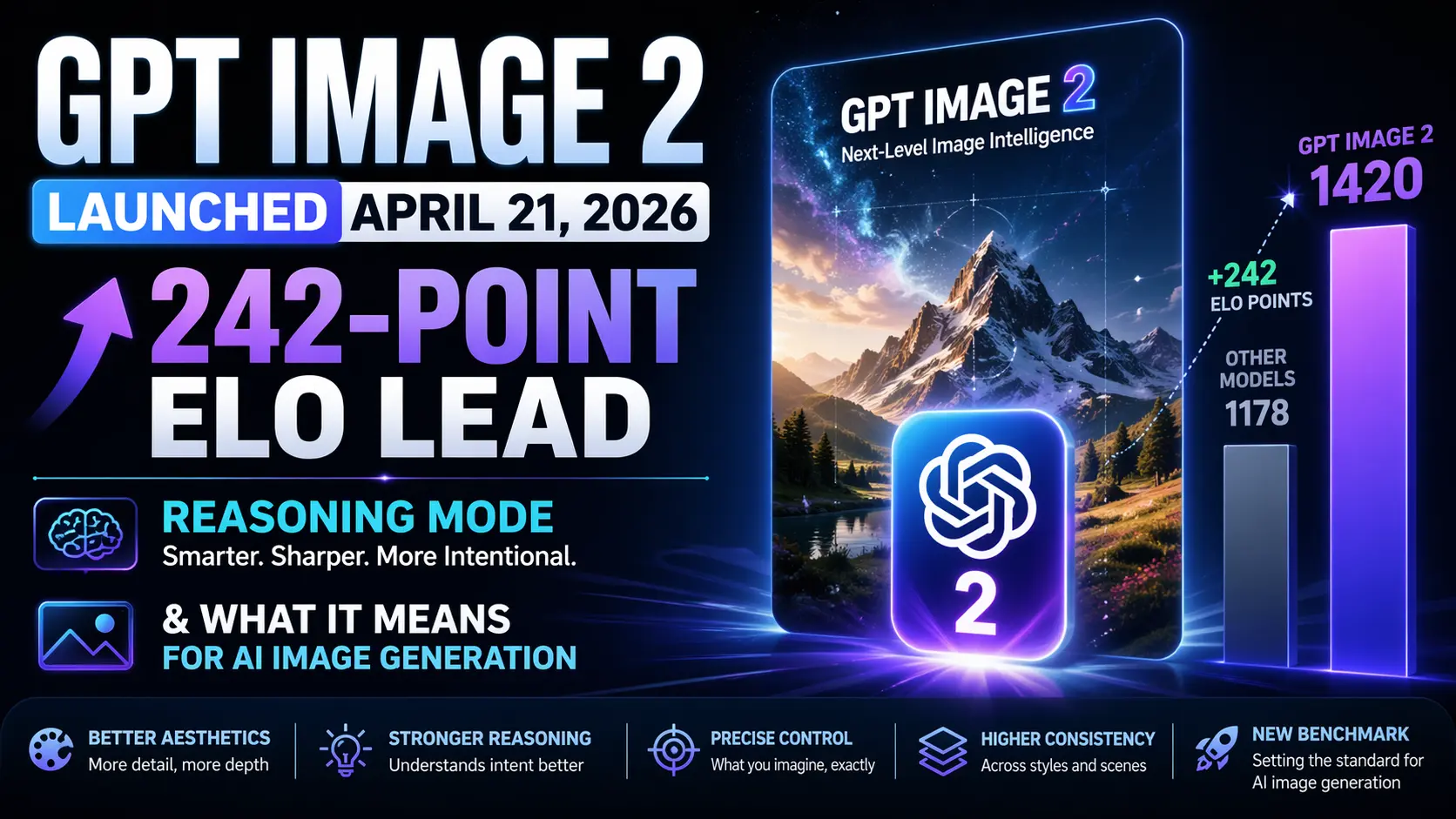
GPT Image 2 Just Broke the AI Image Leaderboard by 242 Points. Here's What That Actually Means.
10 min read
---
---
> Quick Numbers
> - 🚀 April 21, 2026 — GPT Image 2 (gpt-image-2) official launch date
> - 🏆 +242 ELO — GPT Image 2's lead over Nano Banana 2 on Image Arena (largest in leaderboard history)
> - 📊 ELO 1512 — GPT Image 2 text-to-image score; 1513 on single-image edit
> - 🔤 ~99% — text rendering accuracy across any language or script
> - 🖼️ Up to 8 images — generated from a single prompt with consistent characters
> - 📐 2K resolution — up to 3:1 and 1:3 aspect ratios supported
> - ⚰️ May 12, 2026 — DALL-E 2 and DALL-E 3 retirement date
> - 💻 Early May 2026 — full developer API access expected
---
OpenAI shipped ChatGPT Images 2.0 on April 21, 2026 — three days ago — with no keynote, no hype cycle, no weeks of teaser posts. Just a model page that was mostly a gallery, and a leaderboard score that stopped people mid-scroll.
The Image Arena lead of +242 ELO points over the next best model is the largest gap ever recorded on that leaderboard. For context, before this launch, the entire top nine models on LM Arena were separated by only 117 points total. GPT Image 2 didn't just take first place — it broke the competitive cluster that the industry spent 18 months building.
This is worth understanding properly. Not just "what's new" checklist-style, but what actually changed architecturally, who gets what, what it costs, and where competitors still have a genuine leg up.
---
What GPT Image 2 Actually Is
The model is available via the API as gpt-image-2. It's rolling out to all ChatGPT and Codex users right now. The advanced features — specifically the reasoning or "Thinking Mode" — are restricted to Plus, Pro, and Business subscribers.
OpenAI didn't disclose the architecture. They describe gpt-image-2 only as a "generalist model" or "GPT for images." What they confirmed is that it's the first OpenAI image model with native reasoning built directly into the architecture. The model can think before it generates — planning the composition, checking its own logic, and refining outputs across multiple passes inside a single request — rather than just rendering what you typed.
OpenAI calls it a "visual thought partner" rather than a creative toy. That framing is deliberate and actually accurate. This isn't a model for casual Ghibli-style memes. It's aimed at production-ready assets for marketing, education, design, and software development workflows.
> 🔵 On the architecture question
>
> OpenAI's researchers declined to confirm whether gpt-image-2 is diffusion, autoregressive, or something hybrid. Given that GPT Image 1 used visual autoregressive modelling rather than the diffusion approach of DALL-E 2 and DALL-E 3, GPT Image 2 is likely building on that foundation — but with reasoning layers bolted in that didn't exist before. Independent benchmarking of specific failure modes is still early. Take architectural speculation from anyone right now with some salt.
---
The Five Things That Actually Changed
Most launch coverage lists features. These are the five that genuinely shift what the model can do.
1. Text Rendering Is Now Effectively Solved
Two years ago, asking any AI image model to generate a restaurant menu with correctly spelled items was a guaranteed failure. GPT-4o produced "WELCOOMM" instead of "WELCOME." Midjourney gave you "enchuita," "churiros," and "burrto." DALL-E 3 wasn't meaningfully better.
When TechCrunch tested GPT Image 2 by asking for a menu of Mexican food, it created something that could immediately be used in a restaurant without customers noticing something's off.
Text rendering accuracy reportedly jumps from the 90–95% of GPT Image 1.5 to over 99% in GPT Image 2. That's a different product, not a software update. Menus, infographics, banners, UI screenshots, packaging — anything with copy inside the frame is now viable for production use.
The deeper improvement is mixed-script handling. The model can render a Japanese poster with Latin product names, an Arabic restaurant menu with Western prices, or a Chinese movie subtitle layered over an English title. OpenAI specifically called out Japanese, Korean, Chinese, Hindi, and Bengali as languages with significant gains. Mixed-script layouts have been broken in every commercial image model until now — Bengali, Hindi, and Devanagari typography in particular were essentially unusable in DALL-E 3 and Midjourney.
For non-English markets — which means most of the world — this is the first AI image model actually usable for production work outside the Latin alphabet.
2. Reasoning Before Rendering
This is the architectural shift that separates GPT Image 2 from everything that came before it. The model thinks before it draws. It can interpret a brief, understand the intended audience, weigh compositional options, and then generate — rather than just pattern-matching your prompt to a likely image output.
Dwayne Koh, creative strategist at Canva, described early enterprise testing: "The model wasn't just rendering images. It was interpreting briefs, understanding audiences, and making creative decisions behind the scenes."
Practically, this means complex prompts — multiple characters in specific spatial relationships, dense infographics, multi-panel storyboards — work reliably in ways they didn't before. You don't have to learn prompt engineering tricks to get the model to behave. You describe the result you want, and it figures out how to get there.
3. Up to Eight Coherent Images from One Prompt
This one is underreported. GPT Image 2 can generate up to eight images from a single prompt with consistent characters and objects maintained across the full set.
The use cases here are obvious once you see them: children's book page spreads, game cutscene storyboards, multi-format ad campaigns where the same character appears in different scenes, comic panels. Previously, getting character consistency across multiple AI-generated images required complex workflows — seeding reference images, careful inpainting, significant manual correction. GPT Image 2 does it natively in a single request.
4. Multi-Turn Editing Without Drift
In the previous generation, iterative editing was fragile. Ask for a change, get a new image that has subtly re-interpreted everything else too. After two or three rounds of edits, you'd end up with something that only loosely resembled what you started with.
GPT Image 2 handles context-aware multi-turn editing without this drift. You can edit the lighting, then the background, then the text, then the composition — and the model holds the rest of the image stable through each round. That's what makes it a "thought partner" rather than a generator — the conversation has continuity in both directions.
5. 100+ Objects in a Single Scene
Spatial complexity used to collapse AI image models. Put 20 items on a desk, the model starts forgetting some and hallucinating others. GPT Image 2 is reported to handle 100+ distinct objects in a single scene accurately. Dense product photography, detailed architectural interiors, complex UI mockups — these are now on the table.
---
The Two Access Tiers: What You Actually Get
OpenAI split the model into two modes, and the gap between them matters.
Instant Mode — available to all users including free tier. Core quality improvements over GPT Image 1.5 without the reasoning layer. For most everyday tasks — social graphics, product thumbnails, UI mockups, one-off assets — this does the job and costs less.
Thinking Mode — Plus, Pro, and Business subscribers only. This is where reasoning kicks in. Eight-panel storyboards with consistent characters, dense infographics with accurate typography, complex multi-object compositions, mixed-script layouts. This mode takes longer than Instant because the model is actually planning before generating, but the outputs are categorically different.
For 80% of developer use cases, Instant Mode is the right call. The quality jump over GPT Image 1.5 is real even without reasoning. Thinking Mode is where things become genuinely new.
---
Pricing: What It Costs
GPT Image 2 uses token-based pricing:
| Billing Type | Price |
|---|---|
| Image Input | $8 per million tokens |
| Image Cached (repeated reference images) | $2 per million tokens |
| Image Output | $30 per million tokens |
The full developer API opens in early May 2026. Until then, ChatGPT and Codex subscribers access it via the web interface and app. Third-party providers like FAL.AI currently offer proxy API access at approximately $0.01–$0.03 per image during this pre-launch window.
One important note: transparent backgrounds are not yet available at GA. OpenAI plans to add this post-launch with no confirmed timing. If your workflow depends on PNG transparency, you'll need to keep using GPT Image 1.5 for that specific case — it remains accessible via the API for legacy integrations.
---
Where the Competitors Still Stand
GPT Image 2 taking a 242-point lead doesn't mean the other models vanished. Here's the honest state of each.
Midjourney V8 Alpha — still the best for pure aesthetic art direction. There's a cinematic quality to Midjourney's output that GPT Image 2 hasn't closed completely. If your brief is "make this look like a film still" or "concept art for a fantasy world," Midjourney remains the go-to. No API, subscription-only, 30% text rendering rate — those limitations haven't changed.
FLUX 2 by Black Forest Labs — still the strongest open-source option and competitive on photorealism. For teams that need self-hosted deployment, FLUX 2 is the only serious choice. API pricing through FAL.AI at ~$0.03/image also undercuts GPT Image 2 considerably at scale.
Google Nano Banana 2 — now second place on Image Arena (down from first before April 21). Still fastest at 3–5 seconds per image. Still has better multilingual coverage than GPT Image 1.5, though GPT Image 2's script improvements narrow that gap meaningfully.
Ideogram 3.0 — still relevant for text-heavy work at lower price points. For teams that don't need reasoning or multi-image consistency and are primarily generating typography-heavy assets, Ideogram's ~90% text accuracy at lower cost per image remains a viable workflow.
---
The Codex Integration Is the Underreported Story
OpenAI also launched Codex Labs on the same day — April 21 — a technical training and integration service for organisations adopting Codex. The timing isn't a coincidence.
Three million developers use Codex weekly as of April 2026. Giving them image generation natively inside the same workspace they use for code — without a separate API key, billing configuration, or context switch — removes the single biggest friction point for prototyping visual assets inside dev workflows.
You can now generate UI directions and prototypes, compare options side by side, and push the strongest results to live products without switching tools. That's a genuinely different development workflow, not just a feature addition.
The pattern OpenAI is building: ship a strong specialist model, then ship the services that get it into production. ChatGPT Images 2.0 owns the visual creative loop. Codex owns the engineering loop. Codex Labs is the enterprise consulting arm. Anthropic and Google have been executing this pattern for the past year — OpenAI catching up on the enterprise integration side is arguably more strategically significant than the image model itself.
---
What GPT Image 2 Still Can't Do
OpenAI was upfront about the current limits. The model still struggles with tasks requiring a coherent physical-world model — origami guides, Rubik's Cube configurations, objects on reversed or angled surfaces. Very fine or repetitive visual detail like grains of sand can exceed the model's fidelity limits. Labels and part diagrams may need manual review.
Transparent PNG output isn't available yet. The API isn't open to the general developer public until early May. And the input_fidelity parameter is disabled for gpt-image-2 specifically — all inputs are treated as high fidelity automatically, so you can't override it.
These are real limitations for specific workflows. Worth knowing before building a pipeline that depends on them.
---
One Week In: Early Reads
The reception has been strong. GPT-Image-2 is live on API and ChatGPT and looks to leapfrog Nano Banana 2 in the image generation space, with both Thinking and non-thinking variants.
Integrations from Figma, Canva, Adobe Firefly, FAL.AI, and Hermes Agent shipped almost immediately after the launch. That speed of third-party adoption suggests the developer community was waiting for this and had integrations partially built in anticipation.
The +242 ELO lead is large enough that it's hard to dismiss as noise or recency bias in voting. LM Arena scores are from over 4.5 million human preference votes across 54 models. That's a statistically solid sample. If the score holds over the coming weeks as vote counts increase, it represents a genuine step-change rather than an early-adopter surge.
The question now is how long that lead holds. Midjourney, Google, and Black Forest Labs all have model updates in their pipelines. The AI image generation space has moved fast enough that 242 ELO points of lead can erode in months. But as of April 24, 2026 — three days after launch — GPT Image 2 is the most capable AI image model available, and it's not particularly close.
---
> Disclosure: Benchmark scores and pricing are as of April 21–24, 2026. Rankings on LM Arena and Image Arena update continuously. API pricing may change at general availability in May 2026. All architectural claims are based on third-party analysis — OpenAI has not publicly confirmed the underlying architecture of gpt-image-2. Always verify current pricing, access tiers, and capability limits on OpenAI's official documentation before building production workflows.
---
Sources: OpenAI Official Blog "Introducing ChatGPT Images 2.0" April 21 2026, TechCrunch April 21 2026, The New Stack April 21 2026, Latent Space AINews April 21 2026, BuildFastWithAI GPT Image 2 Developer Breakdown, FelloAI GPT Image 2 Analysis, FAL.AI GPT Image 2 Launch Coverage, MindWiredAI GPT Image 2 Complete Breakdown, AwesomeAgents April 2026 Image Model Rankings, Wikipedia GPT Image.
---