
India Government Loan Schemes 2026: MUDRA Tarun Plus, PM Vishwakarma & JanSamarth Updates
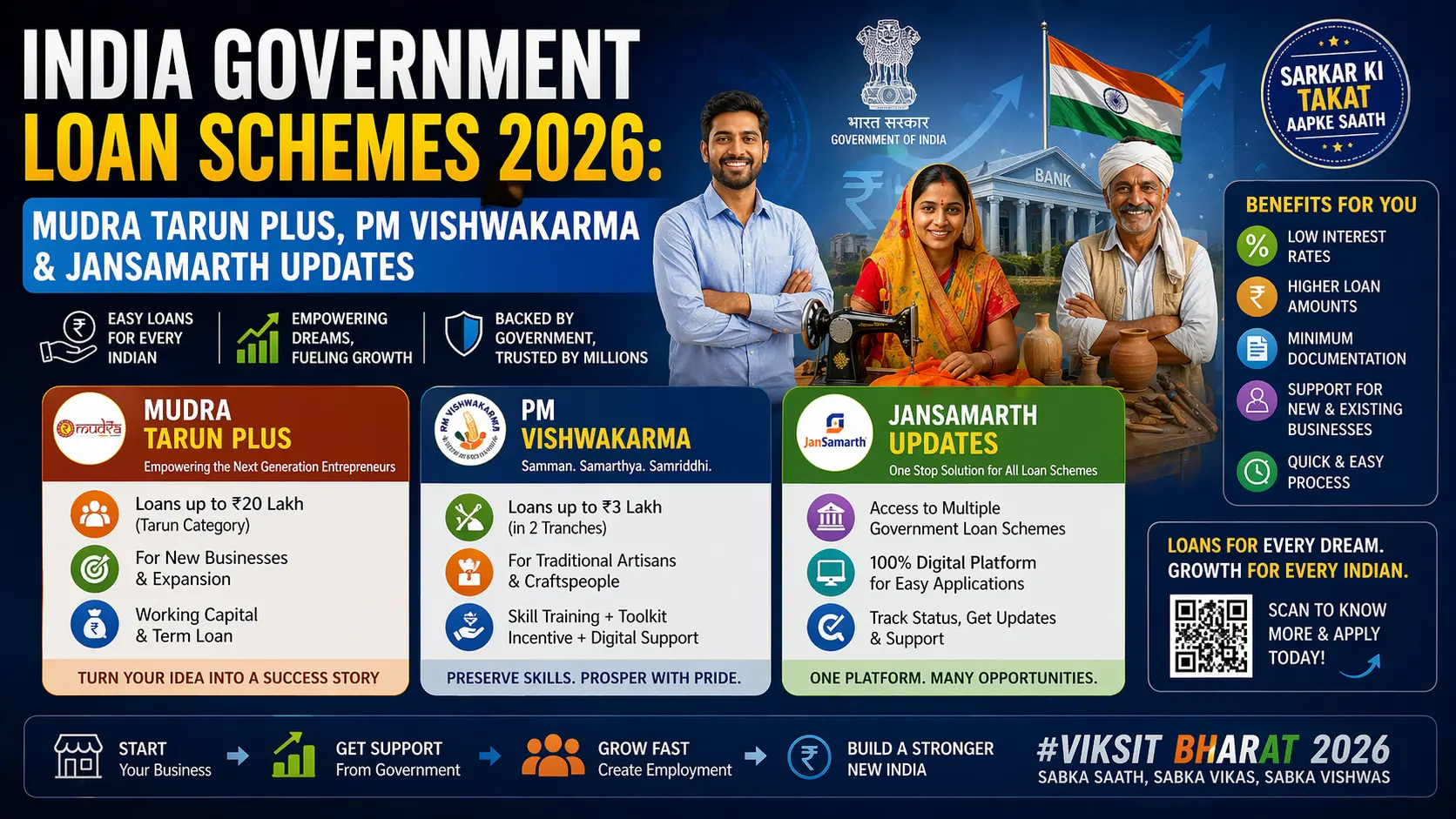
India's Government Loan Schemes in 2026: What's Changed, What's Worth Applying For, and What Nobody Tells You
---
> At a Glance
> - 💼 ₹40.07 lakh crore disbursed under MUDRA since 2015
> - 📈 57.79 crore total MUDRA loans sanctioned to date
> - 🆕 ₹20 lakh — new MUDRA Tarun Plus limit (Budget 2024-25, active 2026)
> - 🧑🎨 29.44 lakh artisans covered under PM Vishwakarma by Feb 2026
> - 🏪 ₹50,000 — maximum loan under PM SVANidhi (Cycle 3)
> - 🖥️ 15+ schemes accessible via the JanSamarth portal in one place
---
Let me be straight about something first. India has a lot of government loan schemes. More than most people can keep track of, each with a slightly different acronym and a slightly different set of rules. Most guides just list them all and call it a day.
This isn't that. Instead, here's a focus on the ones that are actually relevant in 2026 — what's new, what got upgraded, and the parts that most applicants miss until they're already halfway through an application.
---
MUDRA Just Got a New Category — and Most People Haven't Noticed
The headline change that's been quietly working its way through the system: Finance Minister Nirmala Sitharaman raised the MUDRA loan ceiling from ₹10 lakh to ₹20 lakh in Budget 2024-25, creating a new "Tarun Plus" category for borrowers who've already cleared a Tarun loan.
That's real money. The old ₹10 lakh ceiling was a ceiling that a lot of growing micro-enterprises had already hit. Tailors, small transport operators, dairy unit owners — businesses that had outgrown "micro" but weren't quite big enough for the formal MSME lending pipeline. Tarun Plus is designed for exactly that gap.
The catch: only borrowers who have successfully repaid a Tarun category loan are eligible for Tarun Plus. It's not for first-time applicants. Think of it as the government's way of rewarding repayment track record with larger credit access.
Here's where the four categories now stand:
| Category | Loan Amount | Who It's For |
|----------|-------------|--------------|
| Shishu | Up to ₹50,000 | First-time startups, minimal capital needs |
| Kishor | ₹50,001 – ₹5 lakh | Growing businesses needing expansion capital |
| Tarun | ₹5,00,001 – ₹10 lakh | Established businesses scaling operations |
| Tarun Plus | ₹10,00,001 – ₹20 lakh | Prior Tarun repayers, emerging entrepreneurs |
One more thing worth knowing: Shishu loan interest rates run around 10–12% per annum, Kishor loans 11–15%, and Tarun loans 12–16%, all linked to the lender's MCLR or the RBI repo rate. These aren't subsidised rates — MUDRA isn't an interest subsidy scheme. What it gives you is access without collateral, plus a credit guarantee backstop that makes banks actually willing to lend. That distinction matters.
> 🔵 A word on the interest rate question
>
> The most common misconception about MUDRA is that it offers subsidised interest. It doesn't — not directly. The government's contribution is the credit guarantee, which is what lets you borrow without pledging an asset. There is a 2% interest subvention for Shishu borrowers who repay on time, applicable for 12 months — but that's the only direct rate relief in the scheme. Everything else depends on the lender.
---
PM SVANidhi: The Street Vendor Scheme That Actually Works
This one is underrated. PM SVANidhi runs on a tiered credit system: ₹10,000 for the first cycle, ₹20,000 on timely repayment of the first loan, and ₹50,000 for the third cycle. The loan comes with a 7% annual interest subsidy credited directly to the borrower's account every quarter, which effectively brings the real cost of credit very close to zero for someone borrowing ₹10,000.
There's also a cashback component for digital transactions — up to ₹1,200 per year — that doubles as a quiet nudge toward UPI adoption. Not a huge sum, but meaningful for a vendor doing ₹300–500 daily transactions.
Why does it work? Because it doesn't pretend a street vendor has a credit history. The first ₹10,000 is essentially trust-based — the Urban Local Body verifies vendor status, and the loan goes out. Repayment discipline then builds a formal credit footprint that didn't exist before.
After submission of documents and ULB verification, loans are typically sanctioned and disbursed within 7 to 15 working days. That's genuinely fast for government credit.
> 🟢 If you're a street vendor or know one
>
> The SVANidhi cycle 3 amount of ₹50,000 is enough to meaningfully upgrade a cart, buy a refrigeration unit, or bridge a seasonal gap in a food vending business. The first loan is the hardest to get — not because the process is complex, but because most vendors don't know the scheme exists. The application goes through the ULB (your municipal body), not the bank directly.
---
PM Vishwakarma: ₹3 Lakh for Craftspeople, Plus Tools
Launched in 2023, PM Vishwakarma covers 18 traditional trades — carpentry, blacksmithing, pottery, tailoring, and more — with collateral-free loans up to ₹3 lakh, a toolkit voucher of ₹15,000, and a daily training stipend. By February 2026, 29.44 lakh artisans had already benefited.
The loan structure is two tranches: ₹1 lakh over 18 months first, then ₹2 lakh over 30 months once the first tranche is repaid. Interest rate is capped at 5% — which is genuinely subsidised, unlike MUDRA.
What makes this scheme different from just another credit line is the package around it. You get a PM Vishwakarma certificate and digital identity (useful for future credit applications), the toolkit grant upfront, and training that includes both skill upgrading and digital payment adoption. For a carpenter or weaver trying to formalise a decades-old informal business, the certificate alone opens doors that a loan amount doesn't.
> 🟡 The eligibility trap to watch out for
>
> If you have been using MUDRA or PMEGP loan facilities for at least 5 years, you cannot apply for PM Vishwakarma — even if you've fully repaid. It's a scheme designed for people who haven't yet accessed formal credit through other channels. Also, only one member per family can benefit, and government employees and their immediate families are excluded.
---
PMEGP: The Highest Subsidy in Government Lending, But Also the Most Paperwork
The Prime Minister's Employment Generation Programme is where the real subsidy money is. For rural areas, the government covers 25–35% of the project cost outright; for urban areas, the subsidy runs 15–25%. The maximum loan is ₹50 lakh for manufacturing and ₹20 lakh for services.
That's not an interest subsidy — it's a capital subsidy. The government is paying a chunk of your project cost so you never have to repay it. On a ₹30 lakh manufacturing unit in a rural area, that's potentially ₹9–10.5 lakh you don't owe anyone.
The reason more people don't use this: the application requires a proper project report, district industry centre approval, and takes considerably longer than MUDRA. If you're setting up a cold storage unit, a small textile unit, or an agro-processing setup, the effort is worth it. If you're a small trader needing working capital quickly, MUDRA is the faster path.
---
CGTMSE: The Invisible Scheme That Makes Most of the Others Work
Nobody talks about CGTMSE directly because it doesn't lend to borrowers. The Credit Guarantee Fund Trust for Micro and Small Enterprises provides collateral-free loan coverage up to ₹2 crore — 85% coverage for loans up to ₹5 lakh, 75% for larger amounts, and 50% for retail trade.
What this means in practice: when a bank gives you a MUDRA or MSME loan without asking for collateral, CGTMSE is often the silent backstop that makes the bank willing to take that risk. If you default, CGTMSE partially compensates the lender. The borrower doesn't interact with CGTMSE at all — but without it, most of the collateral-free government lending ecosystem doesn't function.
It's worth knowing this exists because it explains something borrowers often find confusing: why some lenders under the same scheme are more willing than others to approve applications. Banks with higher CGTMSE utilisation tend to be more willing to lend to first-time borrowers without assets.
---
JanSamarth Portal: One Login, 15+ Schemes
Before 2024, applying for most government loan schemes meant visiting different bank branches, navigating different portals, and often not knowing whether you were eligible until after filling out half an application. The JanSamarth portal changes that, at least partially.
JanSamarth covers 15+ government-sponsored schemes — MUDRA, PMEGP, PM SVANidhi, education loans, agri infrastructure, Kisan Credit Card, and more — all accessible through a single digital gateway. You check eligibility first, without registering. If you're eligible for multiple schemes, the portal shows you all of them. Then you apply and track status in one place.
It's not perfect. Some scheme-specific processes still require a physical bank visit for document verification. But for someone in a Tier-2 city who previously had no way to know whether they qualified for Stand-Up India or PMEGP without physically visiting a bank, it's a meaningful improvement.
Application process in four steps: check eligibility without registering → create an account and select scheme → upload KYC and business documents → track status digitally. The portal is at jansamarth.in.
---
Stand-Up India: Still the Best Option for Women and SC/ST Entrepreneurs
Stand-Up India is specifically for women and SC/ST entrepreneurs starting a greenfield business — meaning a new venture, not expansion of an existing one. It facilitates bank loans without collateral requirements, with loan amounts between ₹10 lakh and ₹1 crore, covering 75% of the project cost. The application runs through standupmitra.in.
The key thing most guides skip: Stand-Up India loans are composite — they include both term loan and working capital components in a single facility. You're not just getting capex funding; the working capital piece is built in. For a first-time entrepreneur who might not know to ask for working capital separately, this matters a lot.
---
SIDBI SMILE: For Existing Small Businesses That Need Technology Capital
If you run an existing manufacturing or service business and need to upgrade equipment or expand capacity, SIDBI's SMILE scheme is worth knowing about. It provides soft loans from ₹10 lakh for equipment finance to ₹25 lakh for MSME modernisation, with repayment up to 10 years and a 3-year moratorium.
The moratorium is the important part. You don't start repaying principal for three years. That's breathing room most term loans don't give you, and it's designed to match the reality that a manufacturing upgrade doesn't generate returns immediately.
SMILE applies through SIDBI directly or through banks — not through JanSamarth, which is one of those quirks the portal hasn't fully resolved yet.
---
What Actually Gets Loan Applications Rejected
Across all these schemes, a few rejection patterns come up consistently.
Incomplete KYC is the most common. Aadhaar, PAN, and business registration need to match exactly — a name discrepancy between documents kills applications faster than credit scores.
Business activity misclassification is the second one. A lot of applicants apply for MUDRA when their activity falls under agriculture, which MUDRA explicitly excludes. Farm income is not eligible; allied non-farm income from farming-adjacent activities (dairy, poultry, fisheries) is. The line matters.
Applying for the wrong category is also common. A growing business that already has ₹8 lakh in outstanding MUDRA debt applies for Tarun when they should be looking at Tarun Plus — or they've hit the ceiling and need to explore CGTMSE-backed MSME lending instead.
Finally, lender shopping matters more than people think. The same scheme administered by two different banks can have meaningfully different approval rates, processing speeds, and actual interest rates. MUDRA rates alone vary from 10% to 16% depending on the lender and category. It's worth applying to two or three lenders simultaneously rather than treating the first rejection as final.
---
> Disclaimer: This article covers government schemes as they stand in April 2026. Scheme terms, eligibility criteria, and application processes change. Always verify current details through official portals — jansamarth.in, udyamimitra.in, or your bank — before applying.
---
Sources: MUDRA Official Portal, Sarkari Yojana, JanSamarth Portal, SIDBI Government Programmes, CGTMSE, PM Vishwakarma Scheme documentation, FlexiLoans MSME Guide 2026, Drishti IAS PMMY Analysis.