
India Tax Policy 2026: What Actually Changed (And What Didn't) | Budget 2026-27 Guide
Tax & Budget · April 21, 2026 · 7 min read · Union Budget 2026-27
---
Budget day went by, finance minister Nirmala Sitharaman sat down, and Twitter had opinions. But if you're trying to figure out what actually affects your taxes from April 1, 2026 onwards — this is the rundown. No preamble, just the changes that matter.
---
The Big One: A Brand New Income Tax Act
The most significant shift this year isn't a rate cut or a slab tweak — it's that India now has an entirely new Income Tax Act. The Income Tax Act, 2025 replaces the 1961 law effective April 1, 2026. Same rates, same slab structure. Just rewritten from scratch to remove decades of layered amendments, contradictory provisions, and legal jargon that only a handful of CAs could parse without squinting.
The new law also drops the terms "Financial Year" and "Assessment Year" in favour of a single, cleaner concept: "Tax Year." Small change on paper, genuinely useful if you've ever had to explain to someone why the assessment year is always one year behind the financial year.
> Bottom Line: If you're a salaried employee filing your own ITR, the new Act doesn't change what you owe. It changes how the law is written. Your chartered accountant will be more relieved than you are.
---
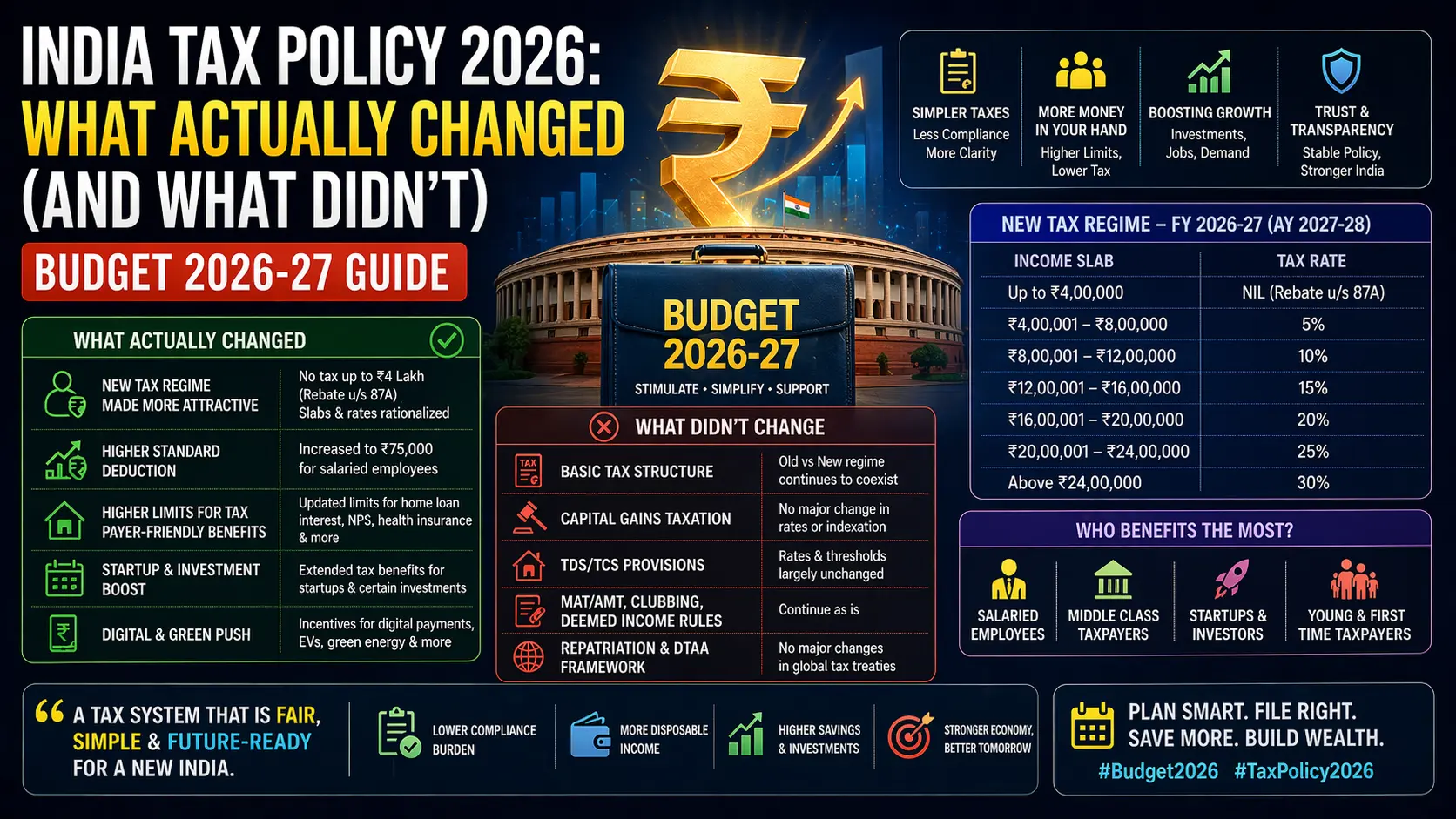
Income Tax Slabs: No Change
The slabs introduced in Budget 2025 carry forward unchanged for FY 2026-27. The zero-tax threshold under the new regime stays at Rs. 12 lakh — which, after the Rs. 75,000 standard deduction, means salaried individuals with gross income up to Rs. 12.75 lakh pay nothing.
| Taxable Income | New Regime Rate |
|------------------------|-----------------|
| Up to ₹4 lakh | NIL |
| ₹4 lakh – ₹8 lakh | 5% |
| ₹8 lakh – ₹12 lakh | 10% |
| ₹12 lakh – ₹16 lakh | 15% |
| ₹16 lakh – ₹20 lakh | 20% |
| ₹20 lakh – ₹24 lakh | 25% |
| Above ₹24 lakh | 30% |
Under the old regime, taxable income up to Rs. 5 lakh remains tax-free with rebate. If you're still on the old regime purely for 80C deductions (PPF, ELSS, life insurance), that path still works — though the new regime remains the default.
---
TCS Rates: Some Go Down, Some Go Up
Tax Collected at Source changes are the ones most people miss until they're staring at a bank statement wondering where 5% went. Here's what shifted from April 2026:
- ⬇️ LRS for education and medical: TCS rate cut from 5% to 2%. This one matters if you're remitting money abroad for a child's university fees or for treatment overseas.
- ⬇️ Overseas tour packages: Flat 2% across the board, replacing the confusing dual structure of 5% up to Rs. 7 lakh and 20% above it. Simpler. Long overdue.
- ⬇️ Tendu leaves: TCS rate reduced from 5% to 2%.
- ⬆️ Alcoholic liquor, scrap, minerals: TCS rate increased from 1% to 2%.
> If you send money abroad for studies: The LRS TCS cut from 5% to 2% is real relief. On a remittance of Rs. 20 lakh, you're now paying Rs. 40,000 instead of Rs. 1 lakh as TCS. It's still refundable if your income is below the taxable threshold, but having less locked up upfront is the point.
---
STT Hike: F&O Traders Take a Hit
The Budget raised Securities Transaction Tax rates, and it's primarily F&O (futures and options) traders who feel it. If you trade derivatives actively, your transaction costs just went up. Equity investors in delivery-based trades are largely unaffected.
This isn't a surprise. The government has been signalling for two years that it wants to cool retail speculation in F&O markets, where a majority of participants statistically lose money. Whether a higher STT actually achieves that is debatable, but the direction is clear.
---
For NRIs and Returning Indians: A Disclosure Window
One of the more underreported changes is the Foreign Assets of Small Taxpayers Disclosure Scheme, 2026 — or FAST-DS 2026 for short. It's essentially an amnesty window for people who have foreign assets (bank accounts, investments, property) that weren't properly declared, usually not out of intent to evade but because the rules around NRI taxation are genuinely complicated.
Small taxpayers who qualify and come forward get graded immunity — limited protection from penalties and prosecution under the Black Money Act — in exchange for paying the applicable tax or a fixed fee. The effective date will be announced separately by the Central Government.
Separately, the Budget also decriminalised non-disclosure of foreign assets (other than immovable property) where the total undisclosed value is under Rs. 20 lakh. That threshold aligns with the existing penalty threshold, which makes sense.
> If You're an NRI or Recently Returned: If you've got foreign assets that haven't been properly reported, this window is worth a conversation with a tax advisor. The alternative — waiting until the department notices — has gotten costlier as data exchange between countries improves.
---
Corporate and Tech Sector: Some Big Incentives
A few Budget announcements stand out on the corporate side, even if they don't touch personal taxes directly:
### Cloud companies using Indian data centres
Foreign companies providing cloud services globally through Indian data centres get a tax holiday until 2047. That's a long-term bet on India becoming a data infrastructure hub, and frankly an unusually long incentive window by Indian policy standards.
### Cooperatives
Inter-cooperative dividend income gets a deduction under the new tax regime. There's also a three-year exemption for dividend income received by notified national cooperative federations on investments made before January 31, 2026. These changes benefit agricultural cooperatives most directly.
### Electronics manufacturing
Non-residents supplying capital goods or equipment to toll manufacturers in bonded zones get a five-year income tax exemption. Part of the broader push to get global electronics supply chains routed through India.
---
ITR Deadlines: A Small but Useful Extension
From April 2026, the ITR-3 and ITR-4 filing deadline for non-audit taxpayers shifts from July 31 to August 31. If you run a business or practice and file ITR-3 or ITR-4, that's a month of breathing room. ITR-1 and ITR-2 filers (most salaried employees) stay on the July 31 deadline.
Revised return filing now gets 12 months from the end of the tax year — up from nine months — bringing the last date to March 31. There's a fee for filing after December 31, but the option being available until March is helpful for people who spot errors late.
---
Penalties: Less Prosecution, More Fixed Fees
The Budget shifts a bunch of procedural penalties from prosecution-style enforcement to fixed graded fees. The penalty for under-reporting or misreporting income now gets imposed directly in the composite assessment order, instead of through separate parallel proceedings. For taxpayers who've been through a notice-and-counter-notice cycle, this is a genuine improvement in predictability.
The penalty rate on unexplained income also drops from 60% to 30%. Still steep, but less extreme than before.
---
The Revenue Picture
Gross tax revenue is expected to grow 8% in 2026-27, which is actually slower than nominal GDP growth of around 10%. Income tax and corporation tax are both projected to grow around 11–12%. The government still carries a shortfall from 2025-26 — income tax came in about Rs. 1.26 lakh crore below revised estimates, partly because of the big tax cuts announced last year. That context matters when you wonder why no major new relief showed up in 2026: the 2025 cuts were still settling.
---
What Hasn't Changed (Quick Recap)
| What | Status |
|------|--------|
| Income tax slabs | No change for FY 2026-27 |
| Rs. 12 lakh zero-tax threshold (new regime) | Unchanged |
| Rs. 1.5 lakh 80C deduction (old regime) | Unchanged |
| ITR-1 / ITR-2 deadline | July 31 (same) |
| Tax audit deadline | October 31 (same) |
| ELSS benefits under old regime | Unchanged |
If you're a salaried individual who files a straightforward return, 2026 is mostly maintenance — same slabs, tighter paperwork rules, and a new law that says the same things in plainer language. The more meaningful changes are for NRIs, F&O traders, overseas remitters, and businesses involved in tech or manufacturing. For everyone else, file by July 31, don't ignore any notices, and double-check whether the new regime actually works out cheaper for your income profile before assuming it does.
---
> Disclaimer: This article is for informational purposes only and does not constitute tax or legal advice. Tax rules can change and individual circumstances vary — consult a qualified Chartered Accountant or tax professional before making decisions.
---
Sources: Union Budget 2026-27 official documents, Ministry of Finance, Income Tax India, PRS Legislative Research, ClearTax, KPMG India.