
Starting a Business in India in 2026: DPIIT Framework, FoF 2.0 & Startup Funding Reality
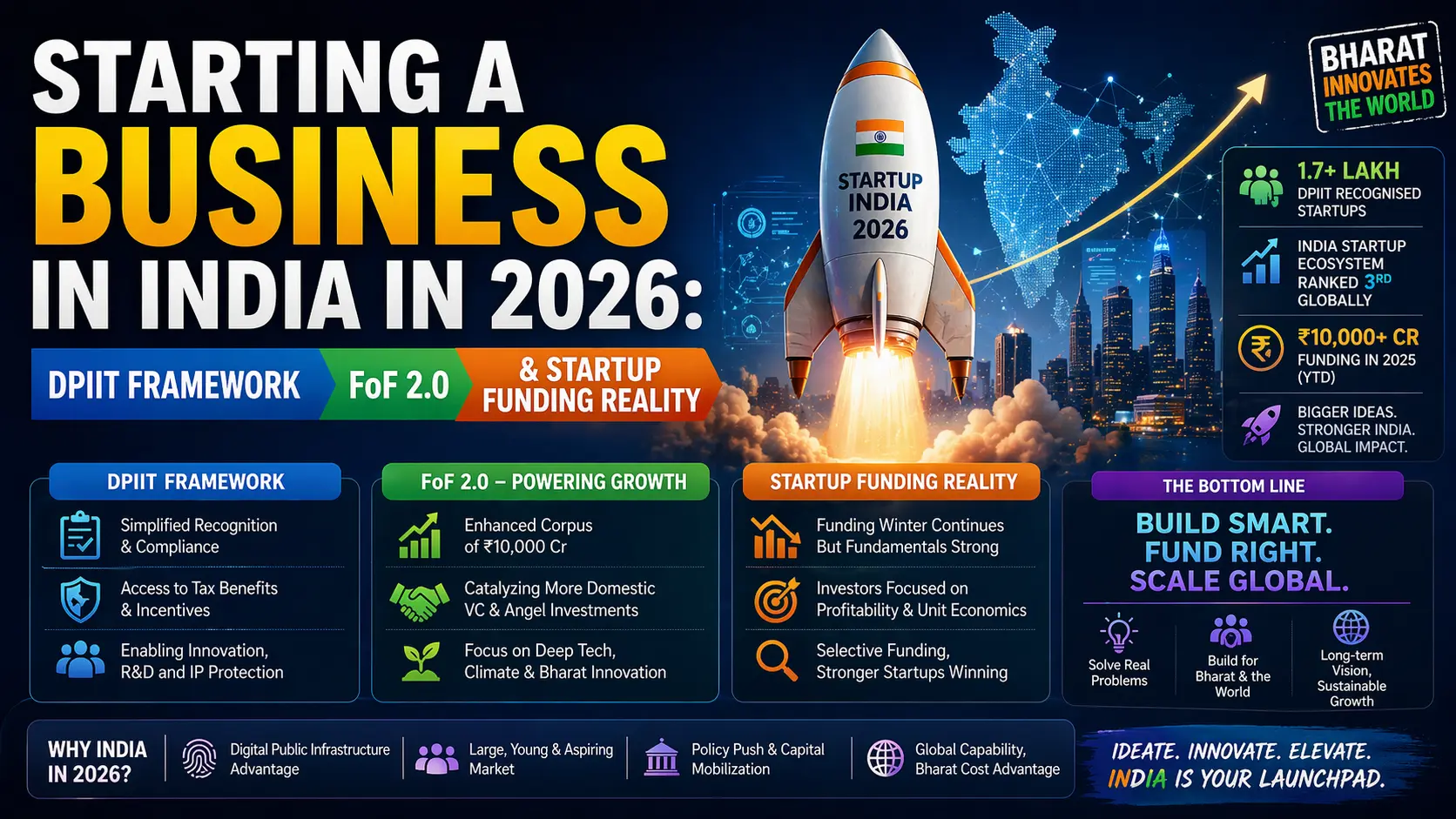
9 min read
---
> Quick Numbers
> - 🚀 2.23 lakh DPIIT-recognised startups as of March 31, 2026
> - 💼 23.36 lakh direct jobs generated by recognised startups
> - 📈 51.6% jump in startup recognition in FY 2025-26 vs FY 2024-25
> - 💰 ₹10,000 crore — corpus of FoF 2.0, notified April 13, 2026
> - 🏙️ 51%+ of recognised startups now from Tier-2 and Tier-3 cities
> - 🦄 127 unicorns produced by India as of April 2026
---
India crossed 2.23 lakh DPIIT-recognised startups in March 2026. That's a real number. But numbers at this scale stop meaning much unless you look at what's actually shifting underneath them — and some things are shifting in ways that matter a lot if you're thinking about starting or scaling a business right now.
This isn't a cheerleading piece. The funding environment has cooled. The rules changed in February. And the ecosystem is going through a maturity phase that looks very different from the 2020-21 growth-at-all-costs era. Here's what's worth understanding.
---
The Framework Changed in February — and Most Founders Haven't Read It
On February 4, 2026, DPIIT issued a new Gazette Notification (G.S.R. 108(E)) replacing the 2019 startup recognition framework. Three changes matter practically.
The turnover ceiling doubled. Startups can now have up to ₹200 crore in annual turnover and still qualify for DPIIT recognition — up from ₹100 crore. This sounds administrative, but it's actually significant. Under the old rules, a business that crossed ₹100 crore in revenue lost access to Section 80-IAC tax holidays and other scheme benefits overnight. That's what the industry was calling the "graduation cliff" — you scaled, and you fell off a ledge of eligibility. The new ceiling buys growing businesses more time inside the support framework.
Deep Tech startups get their own category. For startups working in advanced technology — AI infrastructure, semiconductors, biotech, aerospace — there's now a separate recognition track with a ₹300 crore turnover ceiling and a recognition period of 20 years instead of 10. The reason for the longer window is straightforward: deep tech companies take longer to generate revenue. A company working on novel materials or satellite systems doesn't fit the same 10-year clock as a SaaS business.
Cooperatives can now be recognised. This is a quieter change, but relevant for agri-tech, dairy, and rural-sector businesses that operate through cooperative structures. Previously, cooperatives were excluded from DPIIT recognition entirely.
> 🔵 What this means if you're building
>
> If you already have DPIIT recognition and are approaching the old ₹100 crore turnover threshold, the extended ceiling means you don't need to immediately restructure your entity to retain access to tax benefits. Existing recognition doesn't automatically update — you'll need to check whether re-registration under the new framework applies to your entity. Talk to a CA before assuming continuity.
---
Fund of Funds 2.0: ₹10,000 Crore, But It's Not One Pot
The government notified Startup India Fund of Funds 2.0 on April 13, 2026 — literally eleven days ago. The corpus is ₹10,000 crore, same headline number as FoF 1.0. But the structure is very different.
FoF 1.0 was essentially a single bucket: SIDBI deployed capital to SEBI-registered AIFs, which invested in startups. By end of FY2025-26, roughly ₹7,000 crore had been disbursed to over 135 AIFs, which channelled more than ₹26,900 crore into 1,420+ startups.
FoF 2.0 introduces four distinct segments:
| Segment | Focus |
|---------|-------|
| Segment 1 | AIFs backing deep tech startups (long R&D cycles, novel technology) |
| Segment 2 | Smaller AIFs and micro-VC funds supporting early-stage startups |
| Segment 3 | AIFs funding tech-driven manufacturing under Make in India champion sectors |
| Segment 4 | Stage and sector-agnostic AIFs covering everything else |
The segmentation matters because it changes who gets funded. Under FoF 1.0, capital flowed to wherever AIFs were most comfortable deploying — typically mid-stage B2C tech companies in metros. FoF 2.0 explicitly carves out space for deep tech and early-stage ventures that are harder to fund through normal VC channels.
Returns flow back to the Consolidated Fund of India — it's treated as a revolving investment, not a grant. That's a deliberate design choice to make the scheme fiscally self-sustaining over multiple Finance Commission cycles.
---
The Funding Reality: Strong, but Selective
Here's the honest picture of startup funding in 2026.
Indian startups raised $5.62 billion across 531 equity funding rounds through April 2026. In the same period of 2025, they raised $6.56 billion across 1,020 rounds. That's a 14% drop in total capital and a nearly 50% drop in deal count.
Two ways to read that. One: funding is contracting. Two: fewer deals at similar-ish capital means average deal sizes are larger, and investors are concentrating bets rather than spreading thin. Both readings are partially right.
What's changed since 2022 is the criteria. The post-funding-winter discipline is real. Term sheets now include clauses around unit economics, cash runway, and profitability timelines that weren't standard three years ago. Family offices and domestic institutional funds are playing a larger role, which reduces but doesn't eliminate sensitivity to global VC cycle movements.
> 🟡 If you're fundraising in 2026
>
> Revenue multiples have compressed significantly from 2021 peaks. Investors are valuing sustainable growth over growth-at-any-cost. If your pitch is built around GMV expansion with no clear path to unit economics, you'll struggle. If you can show controlled burn, improving margins, and a clear 18-month milestone plan, you're more fundable than you were two years ago — because fewer companies are showing up with that story.
---
The Tier-2 and Tier-3 City Story Is Now Real
More than 51% of DPIIT-recognised startups are based outside the four major metros. That number was under 30% in 2019. Cities like Jaipur, Indore, Surat, Bhubaneswar, and Chandigarh aren't just producing startups — they're producing startups in sectors where local market knowledge actually matters: agri-tech, regional language content, supply chain logistics, affordable healthcare, vernacular fintech.
This shift has a practical implication for anyone thinking about where to build. Operating costs in a Tier-2 city are genuinely lower — office space, talent acquisition, and mid-level engineering salaries are all 30–50% cheaper than Bengaluru or Mumbai. Customer acquisition for India-specific problems is easier from markets where those problems are visible in daily life, not abstracted behind an urban lens.
The sector clustering that's emerging is interesting too. Indore is building an agri-tech corridor. Surat has textile-tech. Kochi has maritime and logistics. These aren't random — they're rooted in existing regional industry. A startup solving a problem in cotton supply chains is probably better positioned in a cotton-producing region than in a metro that processes the data about it.
---
What the 23 Lakh Jobs Number Actually Means
DPIIT says recognised startups have generated 23.36 lakh direct jobs, up 36.1% from the previous year. Direct jobs — meaning jobs created within the recognised startups themselves, not counting gig workers or supply chain employment.
That's a significant number, but it needs context. India needs to generate roughly 7–8 million jobs per year just to absorb new workforce entrants. 23.36 lakh direct jobs cumulative across a decade of the Startup India initiative tells a partial story. Startups are generating meaningful employment, especially in tech and professional services, but they're not the solution to India's full employment challenge. Manufacturing, construction, and services outside the formal startup definition do most of the heavy lifting there.
What startups do contribute that isn't captured in direct jobs: indirect employment in supply chains, gig work, and the general economic activity that comes from new businesses competing in markets. An agri-tech platform connecting farmers to buyers doesn't just employ its own staff — it reshapes income for thousands of smallholder farmers who aren't counted in its headcount.
---
The Tax Benefit Most Startups Forget to Claim
Section 80-IAC allows DPIIT-recognised startups to claim a complete income tax holiday for any three consecutive years out of their first ten years of operation. The company has to be incorporated after April 1, 2016, and has to have a turnover under ₹200 crore (revised up from ₹100 crore under the February 2026 framework).
The exemption is significant during the growth phase when reinvesting profits matters more than paying tax on them. But a surprising number of startups — particularly ones that didn't work with a tax advisor at recognition stage — either forget to apply for the exemption or don't time their three years optimally. You pick when to start the clock. Picking years when you're actually profitable, rather than burning cash, is the obvious strategy.
The Credit Guarantee Scheme for Startups (CGSS) is another underused facility. By January 2025, only 260 loans worth ₹604 crore had been guaranteed under it. For a country with 2+ lakh recognised startups, that penetration rate is low. CGSS provides collateral-free loan guarantees for startups borrowing from scheduled commercial banks, NBFCs, and venture debt funds. If you're a DPIIT-recognised startup trying to raise debt rather than equity, CGSS is the mechanism that makes banks willing to lend without requiring you to pledge personal assets.
---
What Actually Stops Businesses From Scaling in 2026
The government support architecture is genuinely better than it was five years ago. JanSamarth, FoF 2.0, the revised recognition framework, CGSS — the toolkit has improved.
What hasn't changed: execution bottlenecks at the ground level. GST compliance still costs disproportionate time for small businesses. Labour regulations differ by state in ways that complicate multi-state expansion. The gap between formal credit access and the 57-79 crore micro-enterprise segment that MUDRA serves remains wide.
The Tier-2 and Tier-3 story also has a talent dimension. Building an engineering team in Bhubaneswar or Jaipur is cheaper than in Bengaluru — but the senior talent pool for specialised roles (AI/ML, deep tech, product management) is thinner. A lot of founders in smaller cities are solving this with hybrid models: leadership in a Tier-2 city, specialist roles remote or metro-based. That works, but it requires more intentional culture-building than a colocated team.
The funding selectivity is a double-edged reality too. Founders who bootstrapped through 2022-24 and built real revenue are in a genuinely better position to raise now than founders who need capital to prove out the model. Investors have seen enough failures of growth-first models to be cautious about pure bet plays.
---
Three Things Worth Doing If You're Starting a Business in 2026
Get DPIIT recognition early, even if it feels like paperwork. The tax benefits, credit access, and scheme eligibility that flow from it are disproportionately valuable relative to the effort of getting recognised. The Feb 2026 framework makes it easier to stay recognised for longer as you scale.
Understand whether debt or equity fits your stage. The post-correction funding landscape has made revenue-based financing and venture debt more common and more acceptable. Not every business needs equity dilution — and with CGSS-backed lending now available for DPIIT-recognised startups, debt without collateral is an actual option.
Look seriously at Tier-2 cities if your problem is India-specific. The cost structures are meaningfully better, government support is increasingly available through FoF 2.0 and state-level schemes, and building in a market closer to your customer produces sharper product intuition than building from a distance.
---
> Disclaimer: This article is for informational purposes only. It does not constitute financial, legal, or investment advice. Startup policies, scheme details, and recognition criteria can change — verify current information on official portals including startupindia.gov.in, DPIIT notifications, and jansamarth.in before making business decisions.
---
Sources: DPIIT Gazette Notification G.S.R. 108(E) Feb 4 2026, PIB Startup India Decade Report Jan 2026, BusinessUpturn FoF 2.0 Analysis Apr 2026, Tracxn India Startup Data Apr 2026, Vajiram & Ravi Startup Ecosystem Report, Outlook Business 2026 Playbook, Treelife DPIIT Framework Analysis, Manorama Yearbook FY26 Startup Data.